Somewhere in your organization a 2027 budget line for AI skilling is being finalised this month. Ask what evidence sits underneath it and you will usually find three things: a licence count, a completion rate and a confidence survey. What you will rarely find is an AI-readiness assessment, meaning an objective measure of what your people can actually do with AI. None of the first three measures capability. All three will be treated as though they do.
The number that should unsettle the planning meeting

Researchers publishing in Computers in Human Behavior in February 2026 ran the test a survey cannot. Participants solved twenty LSAT logical reasoning problems with ChatGPT beside them, then estimated how many they had answered correctly. Performance improved by about three points against a norm population. The self-estimate overshot by four.
The second finding is the one that matters for a budget. Higher AI literacy was linked to less accurate self-assessment: the participants with the most technical knowledge of AI were more confident and less precise about their own results. The usual pattern, where weak performers overrate themselves and strong ones self-correct, disappeared once AI was involved.
So the inputs to your skilling decision are not merely imperfect. They are unreliable in a particular direction, and least reliable for the people you trusted most.
What organizations do instead

With no map, breadth becomes the default. Deloitte’s January 2026 study of 3,235 senior leaders across 24 countries found that 53% are focusing on educating the broader workforce to raise AI fluency, while only 19% are designing upskilling and reskilling strategies. Just 20% rate their talent as highly prepared, down from the year before.
Our reading of that pattern, and it is an interpretation rather than a finding, is that a broad fluency programme is what organizations buy when they have never run an AI-readiness assessment and so cannot say who needs what. It assumes a single starting line. It is also the easiest thing to defend in a board paper, because it is visible, countable and fair-looking.
The cost is quiet. Money reaches people who were already competent, producing good attendance and no change, while those with a real gap sit through content pitched at someone else. A year later the completion rate is excellent and the capability picture has not moved.
A scene worth recognising
Consider a financial services firm in Metro Manila that rolls out AI licences to 600 staff with a four-module AI literacy course to match. Completion hits 91% and the CHRO reports a successful programme. She is not wrong about the delivery.
What the course could not know is that about eighty of those people were well past its content, while a different forty had a precise and dangerous gap: they could not reliably tell which claims in an AI-assisted document needed checking against a source. Nobody in that forty would have identified themselves, and by the firm’s usage measures they were among the strongest users.
The programme was well run. It was aimed at an average that did not exist.
The assumption worth challenging

AI capability is not one skill, and it is not evenly distributed. It is a spread of different competencies at different levels in the same office, invisible to every instrument most organizations use.
That is the argument for measuring first. Not because people overstate things, but because the research says nobody can report this accurately about themselves, so no amount of asking will produce the map. Training without it is not reckless. It is expensive guessing with a good completion rate.
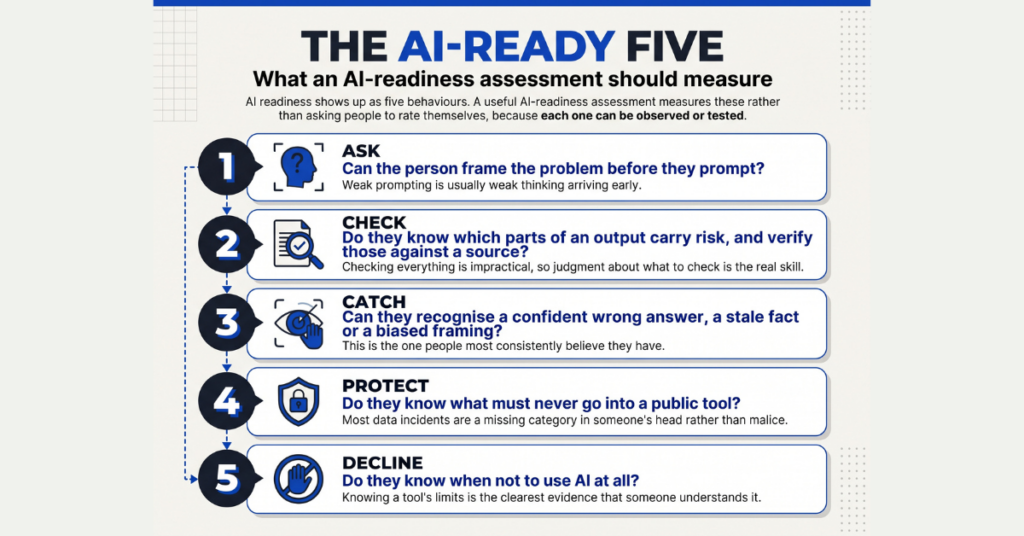
The AI-Ready Five: what an AI-readiness assessment should measure
AI readiness shows up as five behaviours. A useful AI-readiness assessment measures these rather than asking people to rate themselves, because each one can be observed or tested.
The tier above, where the money is larger

The same problem repeats among technical teams, where a wrong assumption costs far more. Claims about machine learning concepts, large language model applications, prompt engineering, retrieval-augmented generation and AI-enabled systems are routinely accepted on the strength of a CV and a confident interview, often by panels with no way to evaluate them.
A misjudged literacy gap wastes a training day. A misjudged RAG capability wastes a hire, a quarter and sometimes an architecture. Yet this is the layer least likely to appear in an AI-readiness assessment, because the people who would run the test are the people being assessed.
What to do differently
CEOs: ask whether an AI-readiness assessment sits behind the figure in the budget paper. If the answer is adoption data or a survey, that is a usage number being presented as a capability number.
HR leaders: baseline before you buy. An AI-readiness assessment costs a fraction of a blanket programme and decides whether that programme is aimed at anything.
Managers: stop asking whether your team checked, and start asking what they checked and against what. The second question is answerable, and surfaces Check and Catch gaps within a week.
Employees: treat your own confidence as unreliable data. The research says this applies most to those who know AI best, which makes it a reason for humility rather than embarrassment.
Technology and transformation teams: test technical AI claims as you would any engineering competence, with work rather than conversation.
What this means for Philippine organizations

Filipino professionals are ahead of the world on AI. 93% of Filipino AI users told Microsoft’s researchers they treat AI output as a starting point rather than a final answer, among the highest rates anywhere, and 65% name critical thinking as the most important human skill as AI takes on more work, the highest of any market surveyed.
That strength raises the stakes on measuring accurately rather than lowering them. Aon’s Human Capital Trends Study 2026 found 72% of Philippine organizations have deployed or are piloting AI and 94% expect AI to reshape roles, while only 17% say they can recruit and retain enough AI-skilled talent. When capable people are scarce and expensive, aiming development spend accurately becomes the main lever available. In BPO and shared services the exposure is sharper, since unverified output becomes a contractual problem rather than an internal one.
What an AI-readiness assessment looks like in practice
This is the gap HR Avatar’s AI-related assessments are built for. At the workforce level they measure AI awareness and literacy, effective prompting, verification of AI outputs, data privacy and security, responsible and ethical use, and practical application in real work. At the technical level they cover machine learning concepts, large language model applications, prompt engineering, retrieval-augmented generation and AI-enabled systems.
The output is not a score to file. It is a map: who is already strong, where the real gaps sit, and which are worth spending on first.
The better question
For two years the question has been whether people would use AI. That one is settled, and in the Philippines the answer is an emphatic yes.
The question the budget turns on is different, and no survey will answer it: are your people ready to work well with AI, and would you know which of them were not before spending the money to find out? That is what an AI-readiness assessment is for, and it is the cheapest line in the programme.
“Training without measurement is not investment. It is expensive guessing with a good completion rate.”
Know the skills you have. Identify the capabilities you need. Build an AI-ready workforce. If you would like to see what an AI-readiness assessment would show for your organization before the next budget is committed, book a session through the ASEAMETRICS Exploratory Meeting Scheduler, or email Charles Benoza at charles.benoza@aseametrics.com to arrange a demo with you and your team.