Learning Teams are being asked to address changing skills, develop programs faster, personalize learning, and prove business impact—often with limited time and resources. The World Economic Forum estimates that 59 out of every 100 workers will require training by 2030, making it difficult for traditional manual processes to keep pace.
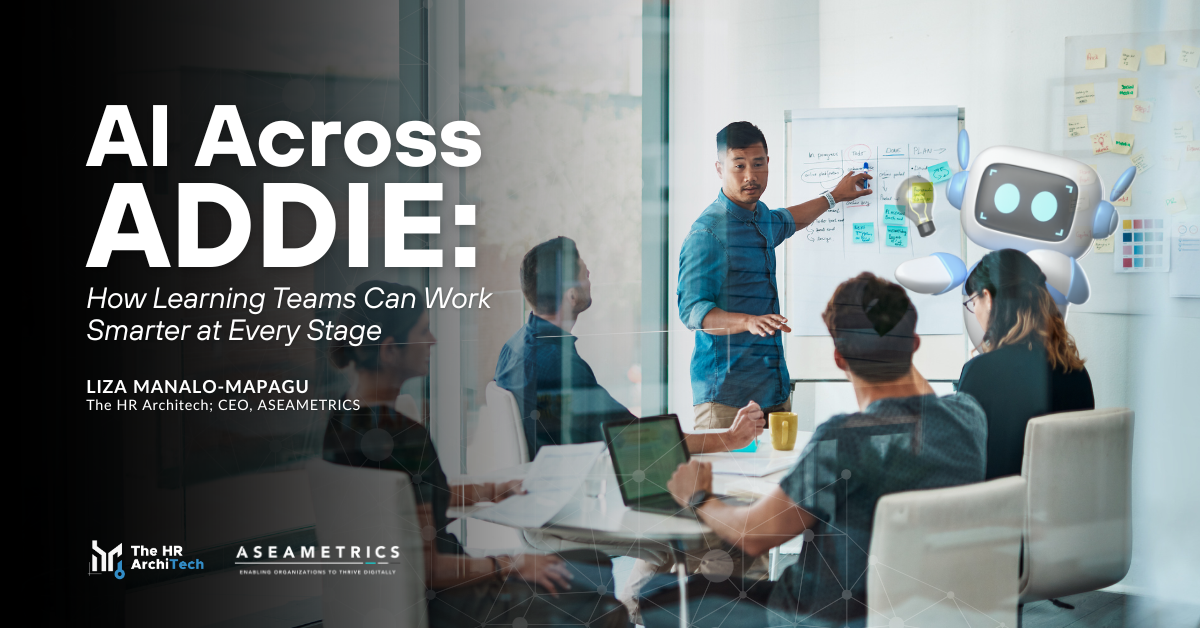
AI offers Learning Teams a practical co-pilot throughout the L&D ADDIE process: Analysis, Design, Development, Implementation, and Evaluation. A study involving instructional designers found that generative AI was already being used for brainstorming, streamlining lower-risk tasks, improving workflows, and supporting collaboration. The same study also identified concerns involving quality, privacy, ownership, and accuracy—reminding us that AI output must always be reviewed.
1. Analysis: Understand the Real Learning Need
Before creating a course, Learning Teams must understand the performance problem, target audience, required skills, and business context.
AI can help teams:
- Summarize interviews, surveys, focus-group notes, and performance reports
- Identify recurring skills or knowledge gaps
- Compare the needs of different roles or learner groups
- Draft learner profiles and initial problem statements
- Organize large amounts of information for stakeholder review
AI can reveal patterns more quickly, but the Learning Team must still validate whether training is the right solution. Some problems may be caused by unclear processes, inadequate tools, workload, incentives, or management practices—not a lack of knowledge.
2. Design: Build a More Focused Learning Experience
Once the need is clear, AI can help Learning Teams explore different ways to address it.
AI can support the development of:
- Clear learning objectives
- Role-based learning pathways
- Course structures and lesson sequences
- Workplace scenarios and case studies
- Practice activities and assessment plans
- Alternative formats for different learner needs
AI can produce several options quickly, but instructional designers must decide which approach is appropriate. Learning objectives, content depth, delivery methods, and assessments must remain aligned with the business need and the realities of the learner’s role.
3. Development: Accelerate the First Draft
Content development is often one of the most time-consuming parts of ADDIE. Generative AI can create text, images, audio, video, and other forms of content, making it useful for producing initial drafts and variations.
Learning Teams can use AI to draft:
- Facilitator and participant guides
- Video scripts and storyboards
- Quizzes and knowledge checks
- Simulations and role-playing scenarios
- Job aids, summaries, and microlearning
- Translations and simplified content versions
The key word is draft. Subject-matter experts and instructional designers must verify accuracy, remove misleading information, check cultural relevance, and ensure that materials reflect organizational policies and practices.
4. Implementation: Support Learners in the Flow of Work
AI can make learning more accessible after a program is launched. Instead of requiring every employee to follow exactly the same pathway, AI can recommend content based on role, experience, existing skills, and development needs.
It may also support implementation through:
- Personalized learning recommendations
- AI tutors or learner-assistance chatbots
- Reminders and learning nudges
- Frequently asked question support
- Facilitator preparation and session summaries
- Just-in-time job support
IBM notes that AI can help organizations provide personalized learning at scale and embed development more closely into how employees perform their work. However, employees should know when they are interacting with AI, what information is being collected, and when human assistance is available.
5. Evaluation: Understand What Changed
AI can help Learning Teams move beyond attendance, completion, and satisfaction scores.
It can analyze:
- Survey ratings and written comments
- Pre- and post-training assessment results
- Knowledge-retention checks
- Simulation and workplace-application data
- Manager observations
- Learning activity across different systems
- Relevant performance and business indicators
Learning standards such as xAPI can capture learner activity and performance inside and outside a formal course, including simulations and workplace experiences. This gives Learning Teams a broader view of how learning is being applied.
AI can identify patterns and relationships, but it cannot automatically prove that training caused a business result. Learning Teams must still consider other factors such as manager support, new technology, incentives, workload, and changes in the operating environment.
Human Judgment Must Remain at Every Stage 
AI is most useful when Learning Teams treat it as a starting point—not a final authority. Microsoft’s 2026 Work Trend Index found that AI users increasingly recognize quality control and critical thinking as essential human skills when reviewing AI-supported work.
Across ADDIE, people must continue to:
- Define the problem
- Set the learning strategy
- Review accuracy and relevance
- Protect employee information
- Make high-impact decisions
- Take responsibility for the final result
UNESCO similarly recommends a human-centered approach that protects privacy and promotes ethical, safe, equitable, and meaningful use of generative AI.
Build an AI-Enabled Learning Function
Through SkillsImpact, ASEAMETRICS helps organizations design structured capability-development programs that connect learning with coaching, workplace application, and measurable results.
Through SkillsTech, we help organizations access digital learning platforms, skills assessments, personalized pathways, learning analytics, and scalable learning technologies.
Together, these solutions can help Learning Teams apply AI responsibly across ADDIE—without losing the expertise, context, and human judgment that make learning effective.
To discuss how AI can support your organization’s learning strategy, schedule a complimentary 30-minute meeting with ASEAMETRICS by sending an email to our Talent Enhancement Officer, Althea Iranta, at althea.iranta@aseametrics.com.