Headcount may be stable. Engagement scores may be improving. Training programs may have high completion rates.
But are critical roles becoming easier to fill? Are employees developing the capabilities needed for transformation? Are your strongest people staying, moving into priority roles, and contributing where the business needs them most?
These are questions that isolated HR metrics cannot answer.
The World Economic Forum reports that 63% of employers globally consider skills gaps a major barrier to business transformation. The challenge is even more immediate in the Philippines: about two-thirds of employers identify skills gaps as a barrier, while 68% of Filipino workers are expected to require training by 2030.
For CEOs, CHROs, HR Directors, and transformation leaders, this matters because workforce decisions are increasingly business decisions. Whether the organization can grow, transform, enter new markets, adopt new technologies, or sustain performance depends heavily on whether it has the right capabilities in the right places at the right time.
People Analytics: What Is It Really? 
People Analytics is not simply a more sophisticated HR dashboard. At its core, it is the use of workforce data to solve business problems and support better decisions.
The CIPD (define) describes People Analytics as analyzing data about people to address business issues. More importantly, it recommends that People Analytics connect people data with business data, help HR design targeted interventions, and measure whether the people function is delivering against its objectives.
That distinction is important. Knowing that turnover is 12%, for example, is useful. But knowing where regrettable exits are concentrated —and understanding what may be driving those exits—is far more actionable.
People Analytics therefore helps leaders move from “What happened?” to more valuable questions: “Where is the issue? What may be driving it? What happens if we do nothing? And what workforce decision should we make next?”
So, Where Does AI Add Value? 
AI does not replace People Analytics, leadership judgment, or workforce strategy. Its value is in helping organizations make sense of workforce information that has become too broad, interconnected, and fast-moving to examine effectively through isolated reports alone.
Consider the number of factors behind something as seemingly simple as retention. Performance, compensation, manager quality, career mobility, skills, tenure, engagement, development opportunities, workload, and role demand may all interact differently across employee populations.
AI and advanced analytics can process these combinations at scale, identify patterns across teams and business units, detect emerging risks, and help leaders forecast possible workforce needs. IBM notes that predictive analytics can use historical information to anticipate staffing needs and potential workforce disruptions, while AI-supported performance analytics can uncover patterns across teams that may be difficult to identify manually.
This is where AI becomes valuable: not because it makes the workforce decision, but because it gives leaders better evidence on which to base that decision.
Instead of reviewing retention, mobility, skills, performance, and learning separately, leaders can begin asking whether those signals collectively support the organization’s priorities.
AI- and Analytics-Enabled Organizations Are Already Showing the Value 
The business case becomes clearer when People Analytics is tied to a defined organizational problem.
At Nielsen, the People Analytics team focused on a specific concern: rising employee attrition. By analyzing employee data, the organization identified key drivers of voluntary attrition and discovered that internal movement was strongly connected with retention. Nielsen subsequently introduced targeted interventions; regrettable voluntary attrition was reduced by nearly half, lateral moves increased by 80% during the first half of 2016, and the company reported millions of dollars in savings.
Schneider Electric approached a different challenge: employees found it easier to leave the organization than to find their next opportunity internally. Its Open Talent Market used AI to match employees with internal roles, projects, and mentors based on skills. By 2023, 85% of eligible employees had registered, 1,500 employees had gained visibility into more than 14,000 open roles that year, 4,000 had found mentors, and 3,000 had participated in internal gig projects.
A global quick-service restaurant company featured by McKinsey shows how the value can extend beyond traditional HR measures. The organization connected workforce, operational, and financial information to understand what was actually driving frontline performance. Four months into its pilot, customer satisfaction had increased by more than 100%, service speed had improved by 30 seconds, new-hire attrition had declined substantially, and sales in the pilot market were up 5%.
These examples point to an important shift. The value of People Analytics is not the sophistication of the model or the number of metrics on a dashboard. It is whether the insight helps the organization improve an outcome that matters—such as critical-role vacancy time, regrettable attrition, internal fill rates, succession coverage, role readiness, productivity, or returns from learning investments.
You Do Not Have to Transform Everything at Once 
For many HR Directors, the concern is not whether better analytics would be useful. It is whether adopting it means purchasing an entire technology ecosystem, integrating every HR system, cleaning years of workforce data, and transforming the whole organization at once.
It does not have to begin that way.
In fact, a more practical approach is to start with one business priority, one workforce decision, and one pilot population.
Suppose the organization wants to improve succession coverage for a group of business-critical roles. Begin by establishing the current baseline. Examine the relevant workforce data, identify the gap and possible drivers, select an intervention, and define the result you expect to see. Then measure whether the intervention actually improves readiness or coverage before expanding it elsewhere.
IBM similarly recommends beginning AI adoption with focused pilot projects that have well-defined use cases, clear success measures, and manageable scope. Lessons from those pilots can then inform broader implementation.
This makes People Analytics far more approachable. Start with a question worth answering. Demonstrate value. Then scale.
From Insight to Action: Where PeopleAnalytics and M&Ensight Fit 
Understanding the problem is only half of the work. A workforce insight creates little value if the organization cannot translate it into an intervention, assign accountability, and determine whether anything changed.
This is why PeopleAnalytics and M&Ensight play distinct but complementary roles.
PeopleAnalytics diagnoses the workforce issue. It helps leaders connect relevant people and business information, establish the baseline, identify patterns and gaps, and better understand where intervention may be needed.
M&Ensight manages what happens next. Once leaders determine the appropriate response, M&Ensight helps define the intervention, assign accountable owners, establish milestones and measures, document expected benefits, and track implementation and results against the organizational goal.
The resulting cycle is straightforward:
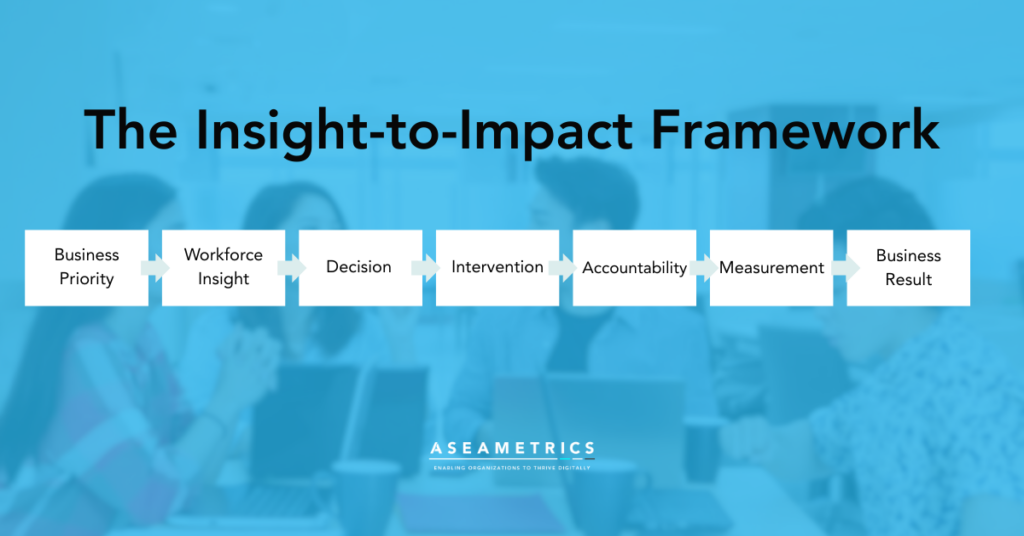
PeopleAnalytics does not replace the decision. M&Ensight does not replace implementation. And AI does not replace leadership.
Together, they give leaders something more useful: a clearer path from understanding a workforce problem to determining whether the organization actually solved it.
The Question HR Leaders Should Be Asking 
People Analytics is ultimately not about having more data. Most organizations already have plenty of it.
The opportunity is to connect that information to the decisions the business needs to make.
Are we retaining the talent that matters most? Are our learning investments developing capabilities the strategy requires? Are employees moving into roles where their skills can create greater value? Are our interventions improving the workforce outcomes they were designed to address?
For leaders, answering those questions can mean the difference between HR reporting what happened and HR helping shape what happens next.
Through PeopleAnalytics and M&Ensight, ASEAMETRICS helps organizations move from workforce insight to measurable action—starting with the business priorities that matter most.
Organizations do not need to begin with everything. Begin with one priority worth solving.
To explore where your organization can start, schedule a complimentary 30-minute discussion with ASEAMETRICS. Contact Charles Benoza at charles.benoza@aseametrics.com.