When the business changes its priorities on a Monday, how long does it take you to know who is ready for the new work? For most organizations the honest answer is weeks, and the answer usually arrives as a spreadsheet that nobody fully trusts.
That delay rarely gets blamed for anything, because it never shows up as a line item. It shows up later as an external hire that did not need to happen, or a capable person who was never considered.
The gap is between seeing and moving

The World Economic Forum’s Future of Jobs Report 2025 found that 63% of employers see skills gaps as a major barrier to transforming their business between now and 2030, and they expect 39% of workers’ core skills to change in that period. Those numbers are usually read as a statement about skills. They are better read as a statement about time. A gap spotted in six days is a very different problem from one spotted in six weeks.
Mercer’s Global Talent Trends 2026 adds the uncomfortable part. Ninety-eight percent of organizations plan org design changes within two years, yet only half of C-suite leaders believe they are investing enough to close the skills gap they expect. Change is planned almost everywhere. The ability to see whether people are ready for it is much thinner.
Why this keeps happening

Workforce information sits in separate places. The HR system knows roles and tenure, the learning platform knows courses completed, and performance reviews hold judgments in free text. Each answers its own narrow question well. None answers the one the business asks, which is who is ready for what we need next.
So someone assembles the answer by hand, in a spreadsheet, over weeks. By the time it is finished the priority has moved, and everyone quietly reaches for the option that feels fast: hire from outside. Organizations tend to read this as a data problem and respond with another skills inventory, which goes stale within a year while the same question takes the same six weeks.
A scenario that will feel familiar

Consider a bank in Metro Manila that decides to move faster on digital lending. The product team needs around forty people who understand credit risk and can work with data. HR is asked a simple question: who in the organization could move?
It takes six weeks to answer, pulling from three systems that disagree about who holds which title. Meanwhile an agency is briefed and recruitment starts. Two months later someone in collections mentions that several of her team have done exactly this kind of analysis for years. Nobody had asked collections, because nothing in the system said to.
This is a composite of a common pattern, not a specific organization. The talent was there. The organization was too slow to see it.
The insight: readiness is a response time

Here is the assumption worth challenging. We talk about readiness as something an organization has: a stock of skills, a completed framework, a green box on a heatmap.
In practice it behaves more like a response time: how many days pass between a business priority changing and a named person starting a move or a development path. That number is rarely measured, and it is the one the business actually feels.
This is where AI deserves a sober word. AI can connect and compile workforce information far faster than a person with a spreadsheet, which is genuinely useful. But a faster report is still a report. If the finding does not lead to a decision about a person, a path or a role, the organization has the same delay with better formatting. Technology creates the possibility. Leaders, managers and employees still decide what to do with it.
The Readiness Loop
Four questions, in order, for any priority the business cares about.
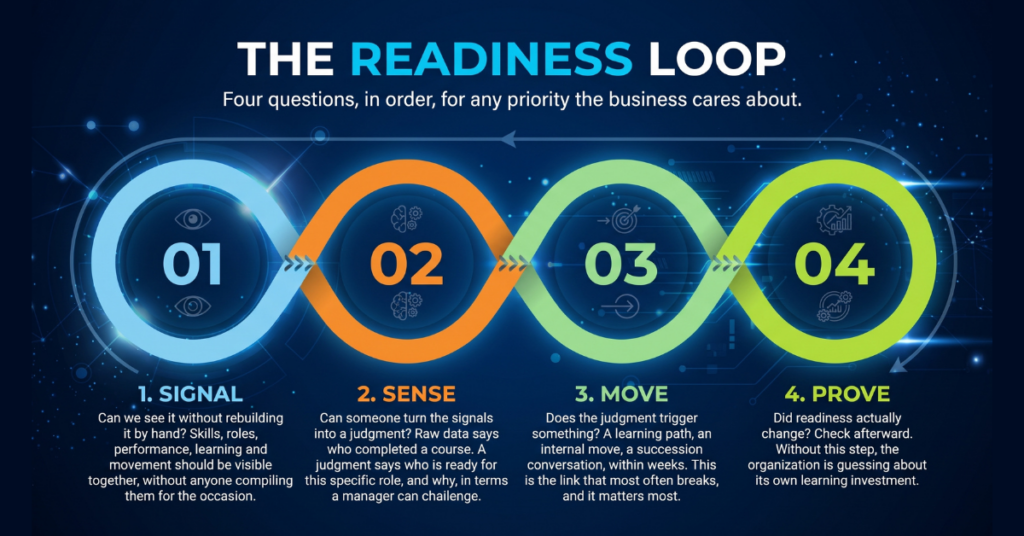
If you can only fix one link first, fix MOVE. Everything upstream is wasted if the finding never becomes a decision.
What to do differently

CEOs: ask for “time to ready” on your three biggest priorities. If nobody can answer, that is the finding.
HR leaders: walk one priority through the loop with a stopwatch and see where it slows down.
Managers: list the data you compile by hand each quarter. That is your Signal problem, written out for you.
Employees: keep your skills and aspirations current. The loop only works if the people in it take part, and stretch assignments are often where readiness is proven.
Technology teams: before adding any AI layer, ask what action it will trigger. If the answer is “a report,” it is solving the wrong link first.
What this means for Philippine organizations

Many organizations here run lean HR teams across multiple sites, with several generations in the same workforce, so manual compilation costs them proportionally more. The IT-BPM sector is aiming for more than two million AI-enabled Filipino digital workers by 2028, and IBPAP’s Jack Madrid has said the industry can no longer be measured mainly by the number of jobs it creates. Moving people into more complex work at that scale is a readiness-speed challenge before it is a training challenge.
It is also a people challenge. In the WEF’s January 2026 briefing, 40% of Filipino entry-level workers said they were worried about AI’s impact on their jobs, among the highest of any country surveyed. Visible, credible paths into new roles are one of the more practical answers. Government agencies reorganizing under the Government Optimization Act will face the same question: who is ready to take on the new mandate?
Where ASEAMETRICS fits
Organizations exploring this usually begin with one priority and one honest look at the loop. ASEAMETRICS helps organizations define what “ready” means for a role, through competency design and assessment, and select and implement the technology that sits around it.
On the technology side, one platform worth knowing is Cornerstone Workforce AI, introduced by Cornerstone in 2026 and described as an intelligence platform for workforce readiness. Cornerstone’s approach follows much the same logic as the loop: connect workforce signals from across the organization, turn them into contextual intelligence, and orchestrate action across learning, development, mobility and workforce planning, with people kept in control of the decisions. It is built on a graph of skills, roles and tasks, so that an emerging skill gap can trigger a learning pathway rather than a report. As with any platform, the useful test is whether it shortens your own time to ready on a real priority.
The question worth taking to your leadership team

The organizations that handle the next few years well will not necessarily hold the most workforce data. They will have the shortest distance between noticing something and doing something about it. If your top priority changed on Monday, how many days would it take you to know who is ready?
“Workforce readiness is not what you know about your people. It is how fast you can act on it.”
Pick one business priority that changed this year. Time how long it takes to answer who is ready, who could be ready soon and what it would take. If the answer is measured in weeks, you have found the problem worth solving first. Explore what shortening it could look like in your organization.
For organizations ready to shorten the distance between spotting a skills gap and acting on it, ASEAMETRICS brings Cornerstone Workforce AI to the Philippines, helping HR and business leaders connect workforce signals, turn them into context-aware intelligence, and act on it across learning, mobility, succession and workforce planning, with people always in control of the decisions.
You may reach out to us through our Talent Assessment Development Officer, Charles Benoza at charles.benoza@aseametrics.com.