Ask a HR and business leader whether their people are using AI at work, and most will say yes without hesitation. Ask the same HR and business leader whether their people are actually good at using it, and the confidence usually drops.
That gap is worth sitting with, because it’s bigger than it looks.
Microsoft and LinkedIn’s 2024 Work Trend Index found that most employees already using AI at work brought their own tools into the job — ChatGPT on a personal account, Copilot picked up on their own, Gemini tested out of curiosity — well ahead of any formal guidance from their employer. People didn’t wait for permission. They rarely wait for training either. And that’s precisely the problem: usage has outrun understanding, and most organizations have no real way to tell the difference between an employee who uses AI well and one who uses it carelessly.
The Real Gap Between AI Adoption and AI Readiness

AI tools spread the way most useful tools do inside a company — informally, person to person, one shortcut at a time. Someone discovers that AI can draft a report outline in seconds, and the habit spreads through the team before anyone in HR or IT knows it’s happening. That’s not necessarily bad. It’s evidence of curiosity and initiative. But it also means capability is developing unevenly and invisibly. One employee might be prompting carefully, checking outputs, and knowing exactly when not to rely on AI at all. Another might be pasting client data into a public chatbot or accepting a confidently wrong answer without a second thought. From the outside, both look identical: “an employee using AI.”
Why Leaders Are Measuring the Wrong Thing

That’s what leaders are getting wrong. They’re tracking adoption — how many people have touched an AI tool — when the number that actually matters is capability: how well those people can prompt, verify, protect information, and know the limits of what they’re using. McKinsey’s 2024 State of AI research captured a version of this mismatch, finding that while regular generative AI use roughly doubled within the organizations surveyed in about a year, comparatively few had redesigned workflows or invested at scale in developing their people’s ability to use the technology well. The tools arrived faster than the readiness to use them responsibly.
If organizations do nothing about this, the risk isn’t dramatic — it’s quiet. Inconsistent quality. Data exposure nobody flagged until it was too late. Decisions made on AI output that no one thought to question. None of it shows up on a dashboard until it becomes a real problem.
A Real-World Example: When AI Usage Numbers Mislead

Imagine a mid-sized BPO in Metro Manila that rolled out an enterprise AI assistant to its operations teams last year. Six months in, usage metrics looked strong — most agents had logged in and used it at least once a week. But when a supervisor sat down with a handful of team leads, the variation was stark. Some had built genuinely smart workflows: better call summaries, faster QA reviews, sharper coaching notes. Others were using it as a search engine and repeating whatever it told them, mistakes included. The usage dashboard told one story. The actual capability told another.
The Key Insight: Treat AI as a Capability, Not Just a Rollout

Most organizations are managing AI as a rollout problem — deploy the tool, watch the login numbers, call it adoption. The more useful lens is to manage it as a capability problem, the same way you’d manage any other core skill: assess where people stand, identify the gaps, and build development around evidence rather than assumption. You wouldn’t judge a sales team’s readiness by how many of them own a CRM login. AI deserves the same discipline.
The Four Layers of AI Readiness Framework
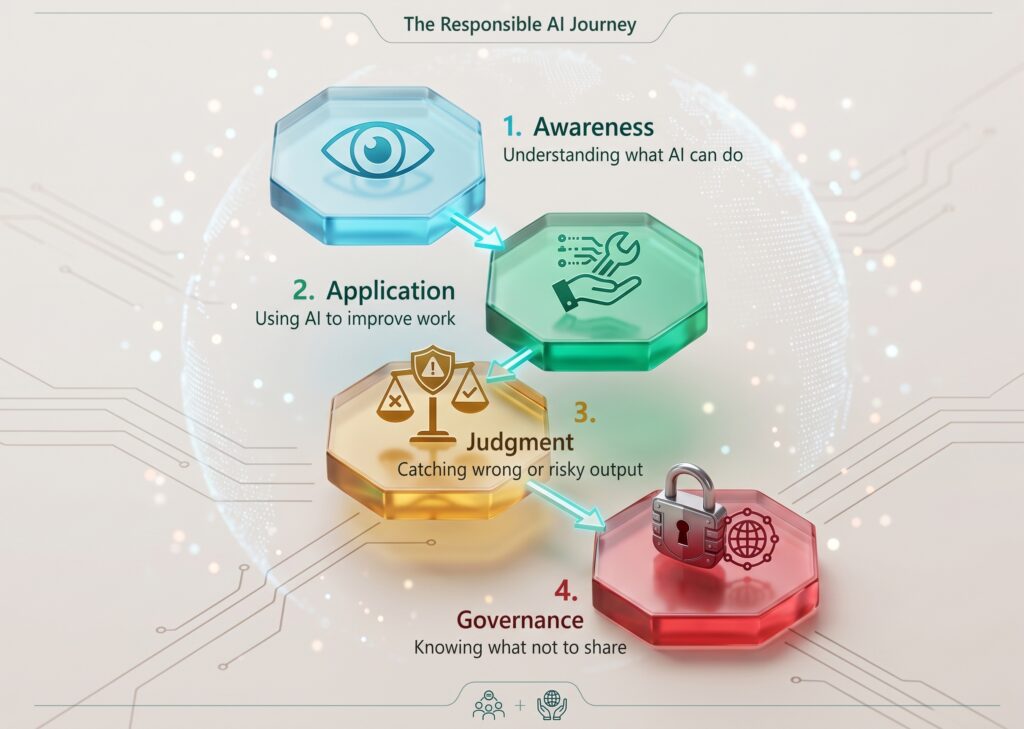
- Awareness — Does the person understand, in practical terms, what AI can and cannot reliably do?
- Application — Can they actually use it to improve real work: better prompts, better outputs, faster decisions?
- Judgment — Can they catch a hallucination, question a confident-sounding answer, and recognize when AI shouldn’t be trusted at all?
- Governance — Do they understand what information should never go into an AI tool, and why?
Most training programs stop at Awareness. Most risk sits in Judgment and Governance.
What HR and Business Leaders Should Do Differently

CEOs — Stop treating AI adoption metrics as a proxy for AI readiness. Ask for capability data, not login data.
HR Leaders — Build a baseline assessment of current AI capability before designing the next wave of AI training. You can’t close a gap you haven’t measured.
Managers — Watch for the quiet variation on your own team. The employee producing the best AI-assisted work is often not the one using it most.
Employees — Get comfortable questioning AI output as a habit, not an exception. Confidence in the answer is not the same as accuracy.
Technology and Transformation Teams — Pair every new AI tool rollout with a readiness check, not just a login count.
What This Means for Philippine Organizations

The Philippines has a genuine advantage here — a workforce that is young, digitally comfortable, and fast to adopt new tools, especially across BPO, shared services, and banking. But that same speed of adoption can outrun governance just as easily as it does anywhere else, particularly in industries handling sensitive customer data or regulated information. For organizations already investing in reskilling and digital transformation, folding AI capability into that same conversation — rather than treating it as a separate initiative — is likely to produce a far more AI-ready workforce than tool rollouts alone.
How to Start Assessing Your Organization’s AI Readiness
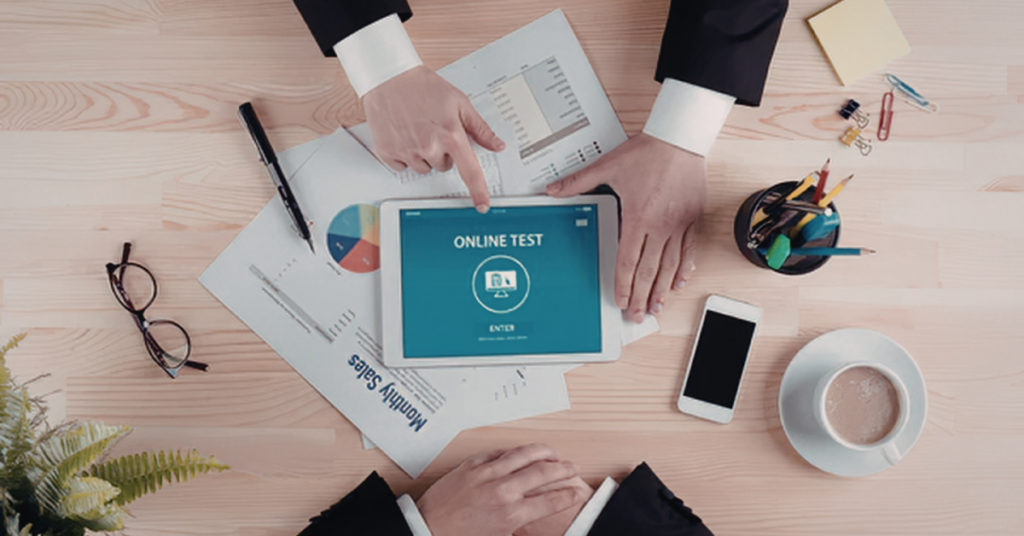
Organizations exploring this challenge may begin by establishing where their people actually stand today — through structured AI readiness assessment for the broader workforce, and deeper technical evaluation for specialist and engineering teams working directly with AI systems. That kind of baseline turns training investment from a guess into a decision.
The Bottom Line: Don’t Assume AI Readiness — Measure It

Don’t assume your workforce is AI-ready because they’re using AI. Assume nothing, and go find out.
“Adoption tells you who touched the tool. Readiness tells you who can be trusted with it.”
If your organization has scaled AI tools faster than it has understood the people using them, that gap is worth closing before it closes on its own. Start with one question: how AI-ready are your people, really?