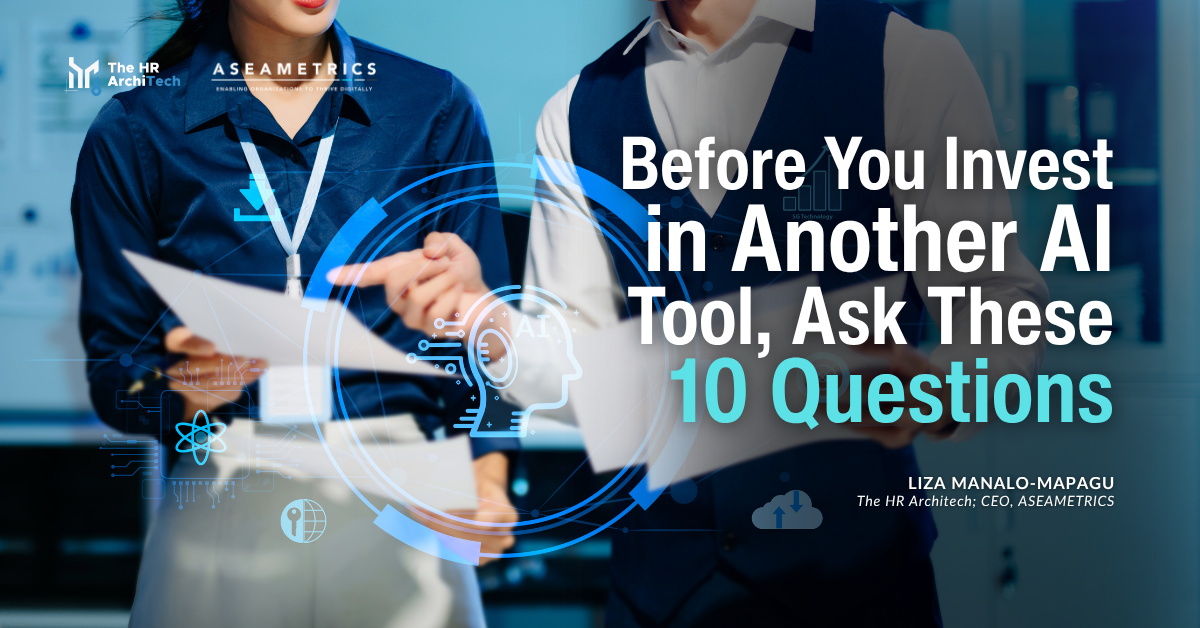
Before you invest in another AI tool, ask yourself this: Is your organization really ready for it?
Over the past year, I have found myself asking this question more often. Like many leaders, I am personally experimenting with AI, piloting different applications within our own organization, looking at where it can improve productivity, and exploring how it can change the way we work. At the same time, through ASEAMETRICS, I have been working with organizations and HR leaders that are also trying to understand where AI fits into their business and how they can prepare their people for what is coming.
What has been interesting is that almost every conversation initially begins with the technology. Someone has seen an impressive demonstration. A new platform promises to dramatically improve productivity. A business unit wants licenses for a generative AI tool. HR wants to explore AI in recruitment, learning, assessment, or people analytics. Leaders understandably become excited about what is possible.
But as soon as an organization begins actually using AI, the questions change.
The conversation is no longer simply about what the technology can do. Leaders begin asking whether employees know how to use it properly, whether company information can safely be entered into the system, whether AI-generated outputs can be trusted, how the organization will measure productivity gains, what happens when the AI makes a mistake, and who remains accountable for decisions influenced by the technology.
That is when the real AI journey begins.
McKinsey’s State of Organizations 2026 captures this tension very well. It found that 88% of organizations are already deploying AI in at least parts of their operations, yet 86% of respondents say their organizations are not very prepared to integrate AI into day-to-day work.
To me, those numbers tell an important story. Organizations are adopting AI faster than they are preparing themselves for AI.
Buying technology is relatively easy. Organizations can purchase licenses, activate platforms, conduct an orientation, and announce that they are now using artificial intelligence. Building an organization in which people, processes, leadership, data, governance, and technology can work effectively together is considerably more difficult.
Through our own AI pilots and our work with organizations, I have become increasingly convinced that AI transformation is not simply a technology implementation. It is an organizational transformation.
That is why, before investing in another AI tool, I believe leadership teams should ask themselves ten questions.
1. What business problem are we actually trying to solve?

One of the easiest mistakes to make with AI is to begin with the technology instead of the problem. There will always be another impressive platform, another new capability, and another demonstration that makes leaders think, “We should have this.”
I understand the temptation because I experience it myself. As someone working closely with HR technology, I am constantly exposed to new solutions. Some are genuinely exciting. But the more we experiment, the more I have learned to ask a more basic question before considering the technology: What problem are we actually trying to solve?
For one organization, the problem may be recruitment turnaround time. For another, it may be employees spending hours searching for information. It might be the amount of administrative work managers perform, the difficulty of personalizing learning, or the challenge of turning workforce data into useful decisions.
Once the problem is clear, the role of AI becomes much easier to define. Without that clarity, organizations can quickly accumulate a collection of disconnected AI experiments. Each may look interesting in isolation, but together they may not contribute to any meaningful business priority.
An AI strategy should therefore start with business outcomes, not with AI tools.
2. Are our leaders aligned on why we are using AI?

Another lesson I have seen repeatedly is that AI means different things to different leaders. A CEO may see AI as an opportunity for growth and innovation. Finance may view it primarily as a way to improve productivity and reduce cost. IT may be focused on cybersecurity and data risks. HR may be thinking about workforce augmentation, capability development, and the impact of AI on jobs.
All of these perspectives are legitimate. The problem arises when they are not brought together into one organizational direction.
Employees become confused when leaders send different signals. They hear that AI will improve productivity, but they may also worry that productivity means fewer jobs. They are told to experiment with AI, while at the same time hearing warnings about data privacy. They may be encouraged to innovate without knowing which tools are approved or what the organization actually expects them to accomplish.
Leadership alignment therefore needs to happen before broad adoption. Executives need to agree on why AI is being introduced, where it should be used, what risks need to be managed, what boundaries need to be established, and what outcomes the organization expects.
McKinsey found that only 14% of surveyed organizations reported leaders consistently championing AI adoption and experimentation through clear strategy and action. That statistic matters because technology can move very quickly, but organizational ambiguity can slow adoption considerably.
Before we ask employees to embrace AI, leaders must first agree on where they are taking the organization.
3. Have we asked our people where AI can actually help?

Some of the best AI use cases do not come from technology demonstrations. They come from listening to employees describe what makes their work unnecessarily difficult.
When we talk with people about AI, I believe one of the most useful questions we can ask is simply, “What takes too much of your time?”
The answers are often very practical. Employees may spend hours consolidating reports, searching through policies, preparing routine communications, reviewing documents, scheduling activities, cleaning spreadsheets, or answering the same questions repeatedly. These may not sound like dramatic AI applications, but collectively they can consume enormous amounts of organizational time.
This is why a needs assessment is so important. Rather than approaching employees with a tool and asking what they can do with it, organizations can begin with their actual work problems and ask whether AI can help solve them.
There is also a human advantage to this approach. When employees are invited to identify the problems AI might address, they become participants in the transformation. AI becomes something being developed with them rather than something being imposed on them.
That participation becomes an important foundation for trust and adoption.
4. Is our data ready for AI?

Once organizations begin asking AI to generate insights, recommendations, summaries, or decisions, the quality of their information becomes much more important.
The principle of “garbage in, garbage out” has been around for decades, but AI has made it even more relevant. An AI system can process poor-quality information faster than any human team ever could, but speed does not make inaccurate information reliable.
In HR, for example, organizations may have duplicate employee records, inconsistent job titles, outdated competency frameworks, obsolete policies, missing information, and several versions of what is supposed to be the same document. If those become the foundation of an AI system, the resulting output may appear sophisticated while still being based on weak information.
Before organizations expect AI to become smarter, they may first need to become more disciplined about their own data.
This means identifying reliable sources of truth, removing redundant and obsolete information, improving consistency, and ensuring that the data used by AI is appropriate for the purpose.
AI readiness, in many ways, begins with data readiness.
5. Do we know how we will measure success?

This is one area where our own experience piloting AI at ASEAMETRICS has influenced how I think about implementation.
It is very easy to be impressed by AI. A task that normally takes an hour suddenly takes ten minutes. A report appears almost instantly. A first draft that would have required considerable effort can be produced in seconds. The immediate reaction is often, “This is amazing.”
But the leadership question needs to go beyond whether a tool is impressive. We need to ask whether it is creating measurable value.
Increasingly, when we pilot AI, I want us to establish the baseline first. How long did the process take before AI? How many people were involved? What did it cost? What was the quality of the output? How many corrections were necessary? What did the employee experience look like?
Then we can compare what happens after AI is introduced.
McKinsey’s research found that tracking well-defined KPIs was among the practices most strongly associated with bottom-line impact from generative AI, yet fewer than one in five respondents said their organizations were doing it.
For HR, measures might include recruitment turnaround time, hours saved in administrative work, employee query resolution time, accuracy, candidate experience, quality of output, learning application, productivity, or return on investment.
The important change is moving the conversation from “The tool seems useful” to “Here is the measurable difference it created.”
AI experimentation is valuable, but eventually leaders need evidence.
6. Have we established clear rules for AI and data?

As AI becomes easier to use, governance becomes more important, not less.
This is particularly relevant for HR because we manage some of the most sensitive information in any organization. Employee records, compensation information, assessment results, performance data, candidate information, succession plans, and career records all require careful protection.
Yet many employees are already experimenting with publicly available generative AI systems. They may not always know what information can safely be entered into these tools, how that information might be processed, or whether the platform has been approved by their organization.
Good governance therefore needs to answer very practical questions. Which AI tools are approved? What information may employees use? What information must remain confidential? Who can access the data? How do vendors manage organizational information? What should happen if there is an incident?
Governance is sometimes perceived as something that slows innovation. I believe the opposite can be true. When employees understand the boundaries, they can experiment with greater confidence.
Clear guardrails can create the psychological and organizational safety necessary for responsible innovation.
7. Are we using AI responsibly, not simply efficiently?

Governance tells us what we are allowed to do. Responsible AI asks a deeper question: What should we do?
This becomes particularly important when AI affects decisions about people. Recruitment, promotion, performance evaluation, learning opportunities, compensation, succession, and careers can all have significant consequences for individuals.
When AI begins influencing these decisions, efficiency should never become the only measure of success.
Organizations need to ask whether an AI system is fair, reliable, transparent enough for its purpose, and appropriate for the decision it is supporting. Leaders should understand where human judgment remains necessary, whether employees or candidates can question an AI-influenced outcome, and who ultimately remains accountable.
My work at the intersection of HR technology and responsible AI has made this especially important to me. I believe organizations should not become afraid of AI simply because risks exist. Neither should we assume that innovation automatically justifies every use of the technology.
Responsible AI is about creating the conditions in which organizations can innovate while protecting people, maintaining accountability, and preserving trust.
AI may augment human judgment. It should not remove human responsibility.
8. Are we truly developing AI capability?

One of the biggest misconceptions about AI adoption is that giving people access to a tool means they now know how to use AI.
They do not.
Employees respond to AI very differently. Some begin experimenting immediately. Others are hesitant or uncomfortable. Some become enthusiastic users but may not fully understand the limitations of the technology. Others learn how to generate impressive outputs but do not know how to validate whether those outputs are accurate.
This is why I believe AI skilling must go far beyond teaching employees how to write prompts.
Employees need to understand how AI applies to their work, how to assess the quality of AI-generated outputs, how to recognize errors and hallucinations, what information must remain confidential, where human judgment is required, and how their work processes may need to change.
The learning also needs to be different for different groups.
Executives need to understand strategy, investment, governance, risk, and workforce implications. Managers need to understand how workflows may be redesigned and how to lead teams in which humans and AI increasingly work together. Employees need practical AI fluency that allows them to apply the technology safely and productively in their own roles.
The World Economic Forum reports that 63% of employers consider skills gaps a major barrier to business transformation, while 59 out of every 100 workers are expected to require training by 2030.
This is why I increasingly describe AI capability development as a learning journey rather than a training program. The technology will keep changing. What organizations need is the ability to keep learning with it.
9. Are we starting small enough to learn before we scale?

There can be enormous pressure on organizations to move quickly with AI. Leaders see competitors announcing new initiatives, vendors present compelling possibilities, and employees are already experimenting on their own.
But moving quickly does not necessarily mean implementing broadly.
Our own experience has reinforced the value of starting with a manageable pilot. Choose a real business problem, identify a group that can test the solution, establish the baseline, agree on the measures of success, and then observe carefully what happens.
Pilots teach organizations things that technology demonstrations cannot.
An AI tool may save significant time, but the quality of the work may still need improvement. Employees may discover applications that leaders did not anticipate. A workflow may need to be redesigned before the technology becomes useful. The organization may discover that more training is required, or it may learn that the problem being solved was not valuable enough to justify the investment.
And sometimes the pilot may tell us that an AI idea simply does not work.
I do not consider that a failure.
The purpose of a pilot should never be to prove that every AI idea deserves to succeed. The purpose is to learn which ideas are valuable enough to scale.
That mindset allows organizations to experiment while managing risk and investment more intelligently.
10. Are we prepared to keep evaluating AI after implementation?
One of the dangers of technology implementation is the belief that the project is complete once the system has been launched.
AI makes that assumption even more problematic.
Business needs change. Organizational data changes. Employees find new ways to use the technology. AI models evolve. Vendors introduce new capabilities. Risks emerge that may not have been visible during the original pilot.
Organizations therefore need to continue evaluating whether the technology remains accurate, useful, fair, reliable, secure, and aligned with the business outcome it was originally intended to support.
Sometimes the evidence will tell the organization to scale the solution. Sometimes the workflow or the technology will need to be recalibrated. And occasionally, the responsible decision may be to stop using a particular application altogether.
Continuous monitoring also creates a learning loop. What an organization discovers during implementation should inform its next strategy, its next training program, its governance policies, and its next investment decision.
This is why I think of AI adoption as a continuing cycle of Trust, Adoption, and Improvement. Trust creates the conditions for people to use the technology. Adoption produces experience and evidence. Improvement uses those lessons to strengthen the system, which in turn builds stronger trust.
The cycle continues.
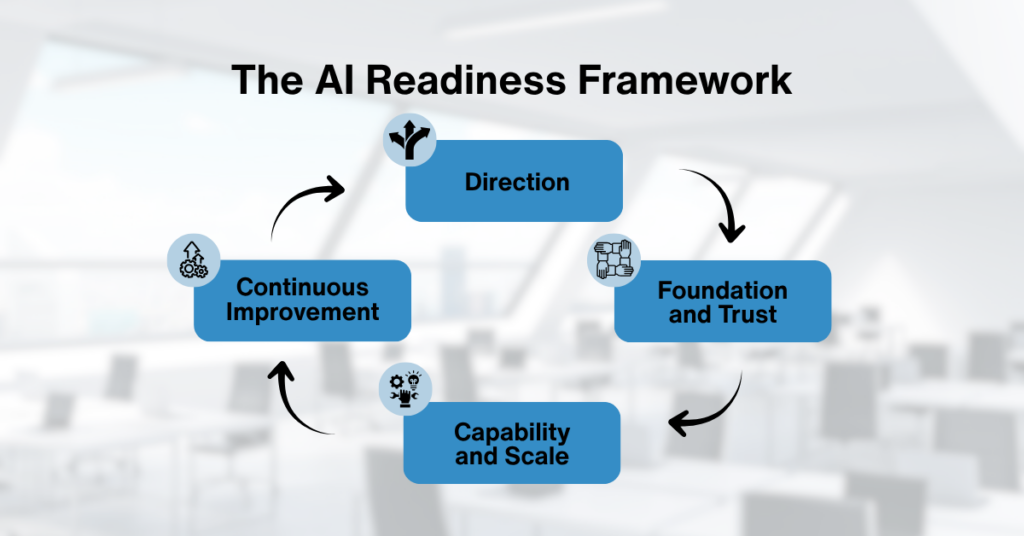
The AI Readiness Framework
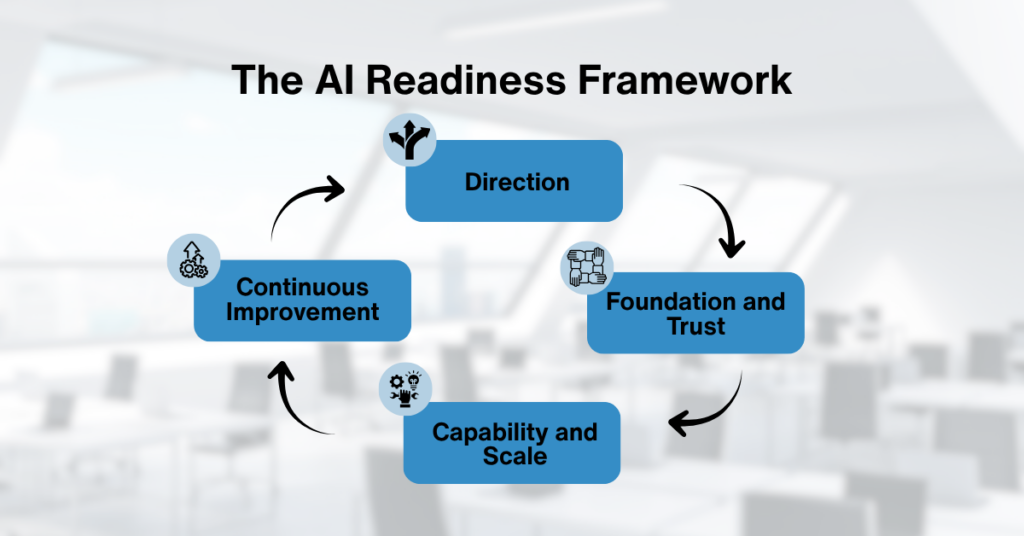
When I look at these ten questions together, I see them as part of four connected organizational challenges.
The first is Direction: Do we know what problem we want AI to solve? Are leaders aligned? Have we listened to the people doing the work?
The second is Foundation and Trust: Is our data reliable? Do we know what success looks like? Have we established governance and responsible AI practices?
The third is Capability and Scale: Are our people prepared to work with AI, and are we piloting carefully enough to learn before expanding?
The fourth is Continuous Improvement: Are we willing to monitor, evaluate, adjust, and sometimes even stop an AI application when the evidence tells us to?
Together, these create an AI Readiness Framework in which Trust leads to Adoption, Adoption creates Learning, and Learning drives Improvement and stronger Trust.
Which organization is actually more AI-ready?

Imagine two organizations.
The first has purchased multiple AI platforms. Different departments are using different tools. Employees have access to several applications, and the organization can proudly say that it has adopted AI. Yet leadership is not fully aligned, governance remains unclear, employees have received little structured development, data quality is inconsistent, and nobody can demonstrate whether the technology has actually improved business performance.
The second organization is doing something much less dramatic. It starts with one carefully chosen problem. Its leaders agree on what they want to achieve. Employees help identify the use case. The organization establishes a baseline, prepares its data, defines guardrails, trains the people involved, runs a pilot, measures the result, and learns from the experience before deciding whether to scale.
Which one is more advanced in AI?
I would argue that the second organization may actually be further ahead.
It may have fewer AI tools, but it has something much more valuable: the organizational capability to use AI well.
The real investment is not only in AI
This is why, at ASEAMETRICS, we increasingly approach AI skilling as more than training people to use today’s newest AI applications.
The tools will change. In fact, some of the tools organizations are excited about today may look very different a year from now. New platforms will emerge, capabilities will improve, and the way we work with technology will continue to evolve.
What needs to endure are the capabilities surrounding the technology.
Employees need the fluency and judgment to work productively and responsibly with AI. Managers need the ability to redesign work and lead human-AI teams. Executives need to understand strategy, investment, governance, workforce impact, and transformation. Organizations need reliable data, meaningful measures, appropriate guardrails, and a culture that is willing to learn.
Ultimately, the goal should not be to create an organization full of employees who know how to use another AI tool. It should be to build an organization that understands why it is using AI, where AI creates value, how it should be used responsibly, and how technology can make people more capable rather than less relevant.
The technology will continue to change. The organizations that succeed will be those that build the capacity to change with it.
So before approving your next AI subscription, platform, or enterprise license, perhaps the most important question is not, “What can this AI tool do?”
It may be:
“Are we investing as much in preparing our organization for AI as we are investing in AI itself?”