As artificial intelligence transforms the workplace, the most important question is no longer how much technology HR will adopt, but how intelligently organizations will redesign work, people capabilities, and decision-making.
The future of Human Resources is being rewritten before our eyes.
Artificial intelligence is changing how organizations recruit, develop talent, manage performance, and make workforce decisions. AI agents are beginning to perform tasks that once required human intervention. People analytics is becoming increasingly sophisticated. Skills are emerging as a new currency of organizational competitiveness.
Yet amid all these technological developments, I believe we are asking the wrong question.
We keep asking: Will AI replace HR? Will HR become leaner? Will HR professionals become obsolete?
Perhaps the more important question is:
Are we architecting HR for the future, or simply automating the HR practices of the past?
As The HR ArchiTech, I have long advocated the strategic integration of people, processes, and technology. Having worked with organizations and HR technology solutions for more than two decades, I have seen how technology can dramatically improve efficiency without necessarily transforming organizational effectiveness.
An outdated process does not become intelligent simply because we automate it.
And a digitally sophisticated HR function does not automatically become a strategically valuable one.
This distinction is fundamental to understanding the future of HR.
Introducing the Intelligent HR Architecture Matrix 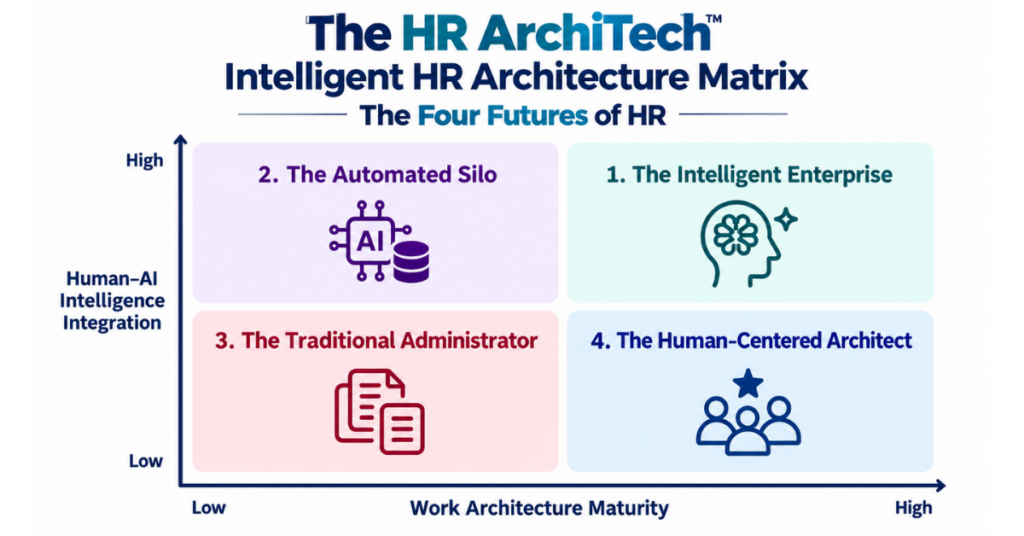
I propose The HR ArchiTech™ Intelligent HR Architecture Matrix, a framework for understanding how organizations can evolve toward a more intelligent, adaptive, and human-centered HR operating model.
The framework considers two critical dimensions:
- Work Architecture Maturity
This examines how effectively an organization designs its structures, roles, capabilities, workflows, and decision-making processes.
At one end are fragmented, function-centered HR practices. At the other are integrated, adaptive, skills-based approaches that continuously evolve with business needs. - Human–AI Intelligence Integration
This examines how effectively organizations combine human judgment, artificial intelligence, data, and technology to create value.
At one end, technology operates as disconnected tools supporting human activities. At the other, human expertise and AI capabilities work together as an integrated intelligence system.
Together, these dimensions create four possible HR operating configurations.
The Four Futures of HR 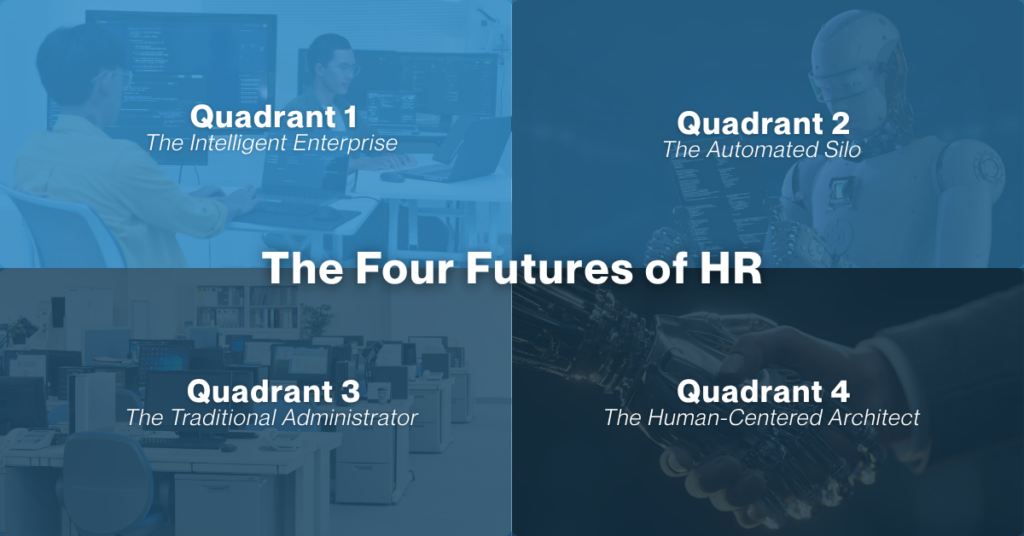
Quadrant 1: The Intelligent Enterprise
High Work Architecture Maturity | High Human–AI Integration
This represents the most advanced configuration.
HR is no longer simply a department delivering programs and services. It becomes an architect and orchestrator of organizational capabilities.
Human expertise, AI agents, people analytics, and digital ecosystems operate within deliberately redesigned workflows.
Recruitment becomes intelligence-driven talent matching. Learning becomes personalized capability development. Workforce planning becomes increasingly predictive and adaptive.
Most importantly, technology does not replace human judgment. It strengthens the organization’s ability to make better decisions while preserving accountability.
Quadrant 2: The Automated Silo
Low Work Architecture Maturity | High Human–AI Integration
This is perhaps one of the greatest risks facing organizations today.
Companies invest heavily in sophisticated AI platforms, automated recruitment systems, chatbots, and analytics dashboards without fundamentally redesigning their HR operating models.
They automate fragmented processes, reinforce outdated structures, and sometimes create new forms of digital complexity.
The organization may become technologically advanced but remain architecturally immature.
Automation without transformation merely makes existing inefficiencies operate faster.
Quadrant 3: The Traditional Administrator
Low Work Architecture Maturity | Low Human–AI Integration
This represents the conventional, largely transactional HR model.
HR functions operate in silos. Processes depend heavily on manual intervention. Technology primarily supports recordkeeping, compliance, and routine administration.
HR professionals spend considerable time processing transactions rather than addressing strategic organizational challenges.
This model may continue to serve certain operational needs, particularly in smaller organizations with limited resources. However, it becomes increasingly difficult to sustain as workforce complexity and expectations grow.
Quadrant 4: The Human-Centered Architect
High Work Architecture Maturity | Low Human–AI Integration
This quadrant challenges the assumption that sophisticated AI adoption is the only path toward HR transformation.
Organizations here have already redesigned work, strengthened leadership, adopted skills-based practices, and developed strategic people capabilities.
Their operating models may be highly effective even without extensive AI integration.
Human judgment, organizational understanding, and strong relationships remain central to how value is created.
For many organizations, this can be an important foundation for responsible AI adoption.
The opportunity is to introduce AI selectively, where it genuinely improves outcomes.
What This Means for Philippine Organizations 
The Philippine business environment presents a particularly interesting opportunity.
Our organizations operate across vastly different levels of digital and organizational maturity—from large enterprises and multinational corporations to family-owned businesses, MSMEs, government institutions, and the rapidly evolving IT-BPM sector.
We cannot assume that a single HR operating model will work for everyone.
For Philippine organizations, the challenge is not simply acquiring AI technology. It is strengthening organizational capabilities, developing AI-ready talent, improving data quality, redesigning work, and establishing responsible governance.
Our cultural emphasis on relationships, empathy, collaboration, and malasakit can be an important advantage—provided these human strengths are deliberately integrated into future operating models.
Responsible AI must also remain foundational. Efficiency cannot come at the expense of fairness, transparency, privacy, or human dignity.
From HR Transformation to HR Architecture 
The four quadrants are not intended to classify organizations permanently or prescribe a single destination.
Different HR activities may operate in different quadrants within the same enterprise.
What matters is whether organizations are making deliberate architectural choices.
Before investing in another AI platform, HR leaders should ask:
- Are we redesigning work or merely digitizing existing processes?
- Are we developing the capabilities people need to collaborate effectively with AI?
- Are our structures, processes, technology, and data working together?
- Are we measuring business and human outcomes—not just efficiency?
- Do we have the governance to ensure AI remains responsible and trustworthy?
The future of HR will not be determined by the number of AI tools we deploy, the size of our HR departments, or the sophistication of our technology investments.
It will be determined by how intelligently we architect the relationship between people, work, intelligence, and technology.
The future of HR is not simply AI-powered. It must be human-centered, intelligence-enabled, and architected for value.
That is the future of HR I believe we should be building.
Discover the right solutions to support your organization’s goals. Schedule an exploratory meeting with ASEAMETRICS to discuss your needs and explore how we can help drive your organization forward.
Contact us at info@aseametrics.com to learn more.