
When budgets tighten, learning is often one of the first things to go.
Travel is cut. Workshops are postponed. Conferences disappear. Training calendars quietly shrink.
On paper, it looks like discipline.
In reality, it can be one of the most expensive decisions an organization makes.
Because while cost pressures may be temporary, capability gaps last much longer.
For organizations in the Philippines facing the ripple effects of oil-driven inflation, global uncertainty, and rising operating costs, the real leadership question is not whether spending should be controlled. Of course it should. The better question is this:
How do we reduce cost without reducing capability?

That is where many organizations get it wrong. They treat learning and development as discretionary when, in times like this, it should be treated as protective infrastructure.
If markets are shifting, technology is advancing, and AI is redefining work, this is not the season to let people stagnate. This is the season to become more precise, more digital, and more strategic about how learning is delivered.
The old model is what should be cut—not learning itself

Austerity does not automatically mean stopping development.
It means rethinking the expensive parts of the old model.
For years, many organizations equated L&D with face-to-face events: hotel function rooms, printed materials, transportation, catering, and full-day workshops that pulled large groups away from work. When pressure hits, that model becomes difficult to defend.
But the lesson from the pandemic was clear: learning does not stop just because the format changes.
During COVID, L&D teams were forced to adapt fast. They shifted to virtual delivery, asynchronous modules, curated content, digital facilitation, and self-directed learning journeys. What started as a response to crisis became proof that learning can be more agile, scalable, and cost-efficient than many leaders had assumed.
That lesson matters now.
Organizations do not need to choose between fiscal discipline and workforce development. They need to choose a smarter learning model.
What smart organizations do when money is tight

The most resilient organizations do not simply ask, “What training can we cancel?”
They ask, “What capabilities must we protect at all costs?”
That mindset changes everything.
Here are five ways forward.
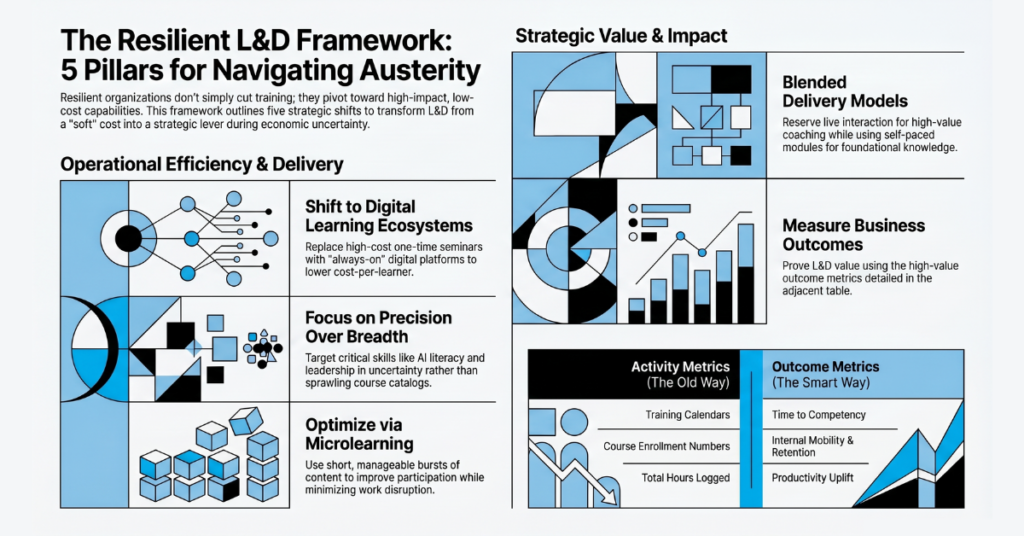
Shift from event-based training to digital learning ecosystems
A one-time seminar may create a moment.
A digital learning ecosystem creates continuity.
Organizations that already use learning platforms, curated online content, and structured pathways are in a stronger position during budget pressure because their cost per learner is lower and their reach is wider. A single subscription or platform investment can support hundreds, even thousands, of learners without the recurring costs of venues and logistics.
This is especially important for geographically distributed teams and organizations trying to scale learning without scaling expense.
The future of L&D is not just digital. It is always-on, flexible, and embedded into work.
Focus on critical skills, not broad catalogs
When budgets are constrained, breadth matters less than precision.
This is not the time to launch sprawling learning menus with vague outcomes. This is the time to identify the few skill areas that will protect business performance and future readiness.
For many organizations today, that includes:
- AI literacy
- digital collaboration
- data handling
- problem-solving
- leadership in uncertainty
- customer responsiveness
- role-specific productivity skills
The key is to build short, targeted learning journeys tied to real business needs. When learning is closely connected to operational priorities, it becomes far easier to defend.
Use microlearning because attention is expensive too
Budget is not the only thing under pressure. Attention is, too.
Leaders are busy. Employees are overloaded. Full-day training sessions are harder to sustain in fast-moving environments.
Microlearning solves more than a scheduling problem. It makes learning easier to consume, easier to apply, and easier to repeat. Short modules delivered in manageable bursts can improve participation while minimizing disruption to work.
When designed well, microlearning does not feel like “extra training.” It feels like immediate support for better performance.
Blend self-paced learning with high-value live interaction
Not every learning experience has to be live.
And not every live session needs to be long.
One of the most effective and cost-conscious models today is a blended approach: self-paced learning for foundational knowledge, followed by shorter live sessions for discussion, coaching, simulation, or application.
This allows organizations to reserve facilitator time for the moments that matter most, instead of using synchronous sessions to cover content that people could learn on their own.
Done right, this approach lowers cost while increasing relevance.
Protect L&D by proving its value in business terms
Perhaps the biggest reason learning budgets get cut is that they are still presented as activities, not outcomes.
If L&D leaders want stronger protection during austerity, they must communicate in the language decision-makers respect:
- time to competency
- internal mobility
- speed of adoption
- manager readiness
- productivity uplift
- retention of critical talent
- reduced hiring dependency
Finance teams are not won over by training calendars. They are won over by evidence.
When learning is measured against business results, it stops looking like a soft initiative and starts looking like a strategic lever.
What leaders need to understand now
The organizations that emerge stronger from uncertain periods are rarely the ones that cut deepest.
They are the ones that cut wisely. They distinguish between spending that is visible and spending that is valuable.
And that distinction matters.
Because when companies reduce learning too aggressively, they may save on this quarter’s expenses while weakening next year’s execution. They slow skill-building, delay digital adoption, increase dependency on external hiring, and leave managers with teams that are less prepared for change.
That is not cost optimization. That is deferred risk.
A better message for HR, L&D, and business leaders

If you are an HR or L&D leader, this is the moment to reposition your function.
Do not defend learning as a nice-to-have.
Defend it as a business continuity tool, a productivity enabler, and a capability engine for a volatile market.
If you are a business leader, ask your team not simply where to cut, but where continued investment will protect your future competitiveness.
Because in an AI-shaped economy, organizations will not win by freezing development. They will win by making learning more accessible, more targeted, more measurable, and more tightly linked to business outcomes.
Final thought
When budgets bite, learning should not be the first casualty.
It should be one of the smartest reinventions.
The organizations that will thrive in uncertain times are not those that stop developing people. They are the ones that learn how to do it better, faster, and more efficiently than before.
And that may be the real competitive advantage of austerity:
it forces organizations to stop spending on learning theater and start investing in learning that truly works.
ASEAMETRICS is an official partner of LinkedIn Learning for premium online course content and a certified provider of the Disprz Learning Experience Platform. To learn how we can help you scale affordable, impact‑driven digital learning, email us at info@aseametrics.com.