
In 2026, leaders are being asked to deliver stronger results while staying disciplined on cost, making sense of AI, and building capability for the future. Workforce decisions can no longer be made in silos.
This is why workforce optimization should be treated as a business strategy, not a collection of separate HR activities. Organizations need a practical way to connect workforce decisions to enterprise outcomes. That is where the ASEAMETRICS SHAPE Framework comes in.
What SHAPE means 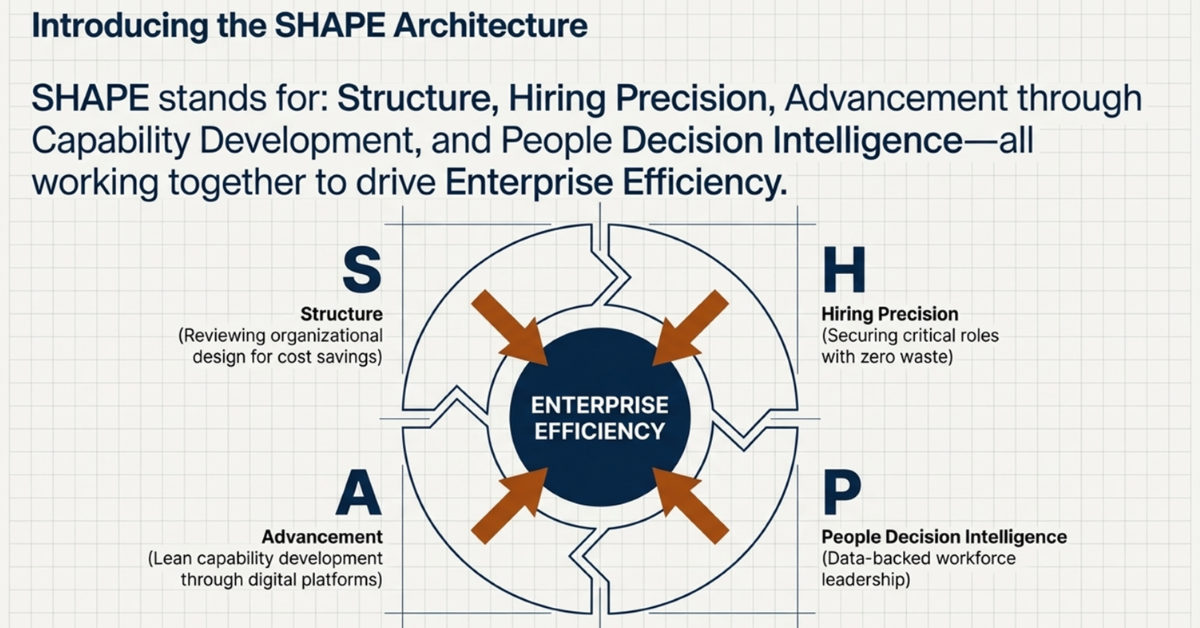
SHAPE brings together five connected ideas that help organizations improve workforce performance in a more deliberate way:
S – Structure Review organizational design, role clarity, workforce deployment, and where friction is slowing execution. Many performance issues are structural before they are technological.
H – Hiring Precision Improve hiring quality through better role profiling, validated assessment methods, and more disciplined selection. The goal is not simply to hire fast, but to hire well.
A – Advancement through Capability Development Build the skills, leadership readiness, and targeted learning the business actually needs. Capability development becomes more effective when it is tied to future roles and real performance gaps.
P – People Decision Intelligence Use workforce data, talent insights, and people analytics to help leaders make better calls on hiring, deployment, development, performance, and organization design.
E – Enterprise Efficiency The outcome of the first four pillars working together: better alignment, stronger productivity, improved decision quality, and greater readiness for growth.
Why DARE to SHAPE works 
The strength of this framework is that SHAPE is not just a message. It becomes actionable through the ASEAMETRICS DARE process. DARE is the method. SHAPE is the workforce optimization strategy.
Define | Clarify the business problem, workforce priorities, critical roles, and target outcomes. |
Assess | Diagnose the current state across the SHAPE pillars using workforce data and stakeholder input. |
Realize | Design and activate the right interventions in structure, hiring, capability development, or decision support. |
Evaluate | Measure outcomes, adoption, and business value over time. |
A practical starting point for leaders 
- Where is work slowing down because of unclear roles, approvals, or handoffs?
- Which hiring decisions most affect productivity, quality, or customer outcomes?
- Are learning investments aligned to the capabilities the business needs next?
- Do leaders have real workforce insight, or only reports with limited action value?
Next Step
If your organization is trying to improve workforce performance, reduce friction, or get more value from existing people and technology investments, a focused exploratory conversation is the most practical place to begin. A 30-minute meeting can help identify where workforce value is being lost and which SHAPE priority to address first.
Workforce optimization is not about exhausting people. It is about designing the workforce more clearly, using evidence more intelligently, and improving business performance with purpose.