
Ask your employees whether they are ready for AI and about seven in ten will say yes. Ask your leaders whether the organization is ready for what comes next and fewer than three in ten will.
That gap, which McKinsey measured in a readiness panel earlier this year, is the most useful number in the current AI conversation. It says the constraint has moved. It is no longer the people.
For Philippine organizations the finding is sharper than it first appears. Filipino professionals are measurably ahead of their global peers on AI use, which means the ceiling here is being set by employers rather than by talent. We will come back to what the local numbers show.
Productivity that does not arrive 
The same McKinsey research, published at the start of October, found that 80% of respondents say AI has improved their personal productivity. Only 37% report a positive EBIT impact. Six per cent qualify as high performers.
Set those three numbers next to each other and you have the shape of the problem. Almost everybody is faster. Roughly a third of organizations can see it in the financials. A very small group is genuinely getting the benefit.
This is not a story about AI failing to work. It works. It is a story about where the gains stop.
Where the time actually goes 
When an individual saves forty minutes, that time belongs to them. It gets absorbed into the rest of the day, spent on the backlog, or returned as slightly less pressure. None of that is bad. None of it reaches the business either, because the business does not run on individual minutes. It runs on cycle times, handoffs, error rates and decisions.
There is a sharper version of this problem, and it now has a name. Researchers at BetterUp Labs and Stanford Social Media Lab surveyed 1,150 US desk workers last year and found that 41% had received what they call workslop: AI-generated material that looks finished but carries no real thinking, so the recipient has to do the work anyway. Each instance cost around two hours of rework, which the researchers put at roughly 186 US dollars per employee per month.
The social findings were worse than the financial ones. Just over half of recipients were annoyed, a fifth were offended, and nearly half thought less of the sender’s judgment afterwards.
Workslop is what individual speed looks like when it arrives without shared standards. One person’s forty minutes saved becomes two hours spent by someone else, and a quiet loss of trust between them.
A scene that will be familiar 
Consider a shared services team in Metro Manila where AI use is close to universal. Analysts draft faster. Reports arrive earlier. Everyone reports feeling more productive, and they are not imagining it.
Yet the monthly close takes the same number of days it always did. The reviewer at the end of the chain is now spending longer on checking, because more of what reaches her looks right and is not. The process map has not changed since 2023. When the client asks what AI has delivered, the operations head can describe a great deal of activity and cannot point to a single number that has moved.
Nothing failed. The organization simply never changed anything other than the speed of the first draft.
Capability is not an individual property 
Here is the assumption worth challenging. Most AI capability programmes are built around the individual. Train people on the tools, certify them, move to the next cohort. It feels like progress because attendance is easy to count.
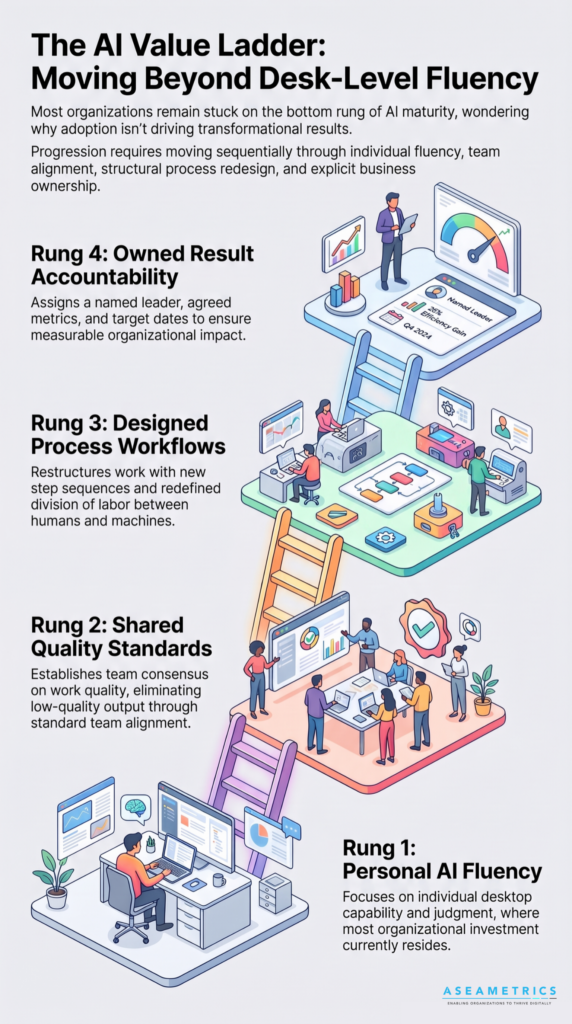
But the evidence points somewhere else. In McKinsey’s analysis, nearly three-quarters of AI high performers had substantially redesigned their workflows, compared with about a quarter of everyone else. The differentiator was not how many employees had been trained. It was whether the work itself had been reorganized around what AI can now do.
AI capability behaves less like a personal skill and more like a team sport. An individual can be fluent. Only a team can agree what good enough means before something is passed on. Only an enterprise can decide which processes get rebuilt, what the guardrails are, and how the value will be measured. Skip those two levels and you are funding a large number of faster individuals inside an unchanged organization.
The AI Value Ladder
What to do differently 
- CEOs: stop asking how many people have been trained. Ask which process has been redesigned, and what moved as a result.
- CHROs and HR leaders: this is an organizational capability agenda, not a course catalogue. Start where AI-Q starts, with leadership alignment on purpose, priority use cases and guardrails, because teams cannot set standards that leaders have not agreed.
- Managers: set a quality bar for AI-assisted work in your team this month, and apply it to your own output first. The workslop research suggests this single habit protects both your cycle time and your team’s trust in each other.
- Employees: your judgment is the part that cannot be automated. Treat checking as the skill, not the chore.
- Technology and transformation teams: resist the instinct to roll out more licences. Pick one end-to-end process, redesign it with the people who run it, and measure it properly.
What this means for Philippine organizations 
The Philippine position here is genuinely strong, which makes the risk of stalling more frustrating.
Microsoft’s 2026 Work Trend Index found that 25% of Filipino workers qualify as Frontier Professionals, against 16% globally, and that 35% say their leadership is clearly aligned on AI, compared with 26% worldwide. Filipino professionals are ahead on adoption and ahead on alignment.
The same research also found that 53% say it feels safer to focus on current priorities than to redesign work with AI. That sentence describes the bottleneck exactly. The appetite is here. The permission to change how work is done is what is missing.
For the BPO and shared services sector this is not an abstract question. Clients will increasingly expect AI-driven gains to show up at the contract level, in cost, cycle time and quality. Gains that live inside individual productivity cannot be priced, cannot be guaranteed, and cannot be defended in a renewal conversation.
Where ASEAMETRICS fits 
Our view, and the reason AI-Q exists, is that AI adoption is not a technology project. It is an enterprise capability challenge, and it has to be built at all three levels: the individual, the team, and the organization. That means starting with leadership alignment, then developing judgment through work people are actually doing rather than through training that ends in a classroom.
Organizations wanting to test their own position can start with a conversation. We run a complimentary one-hour executive briefing with our CEO, Liza Manalo-Mapagu, and lead consultant Dominic “Doc” Ligot, on a single question: where should AI take your organization, and what capabilities must your people build to get there?
The question for the board 
For two years the question has been whether people would adopt AI. That question is settled, and the answer was yes, faster than most leaders expected.
The question for the next two years is harder and much less comfortable. Your people have changed how they work. Has your organization changed anything at all?
“AI fluency is personal. AI value is organizational. Most companies are funding the first and reporting on the second.”
Take one process where AI use is already universal and ask three questions: where did the saved time go, what standard does AI-assisted work have to meet before it is passed on, and who owns the outcome. If those answers are unclear, the gap is not in your technology. Assess where your organization currently stands before committing another year of budget.
You may reach out to us through our Talent Assessment Development Officer, Charles Benoza at charles.benoza@aseametrics.com.